

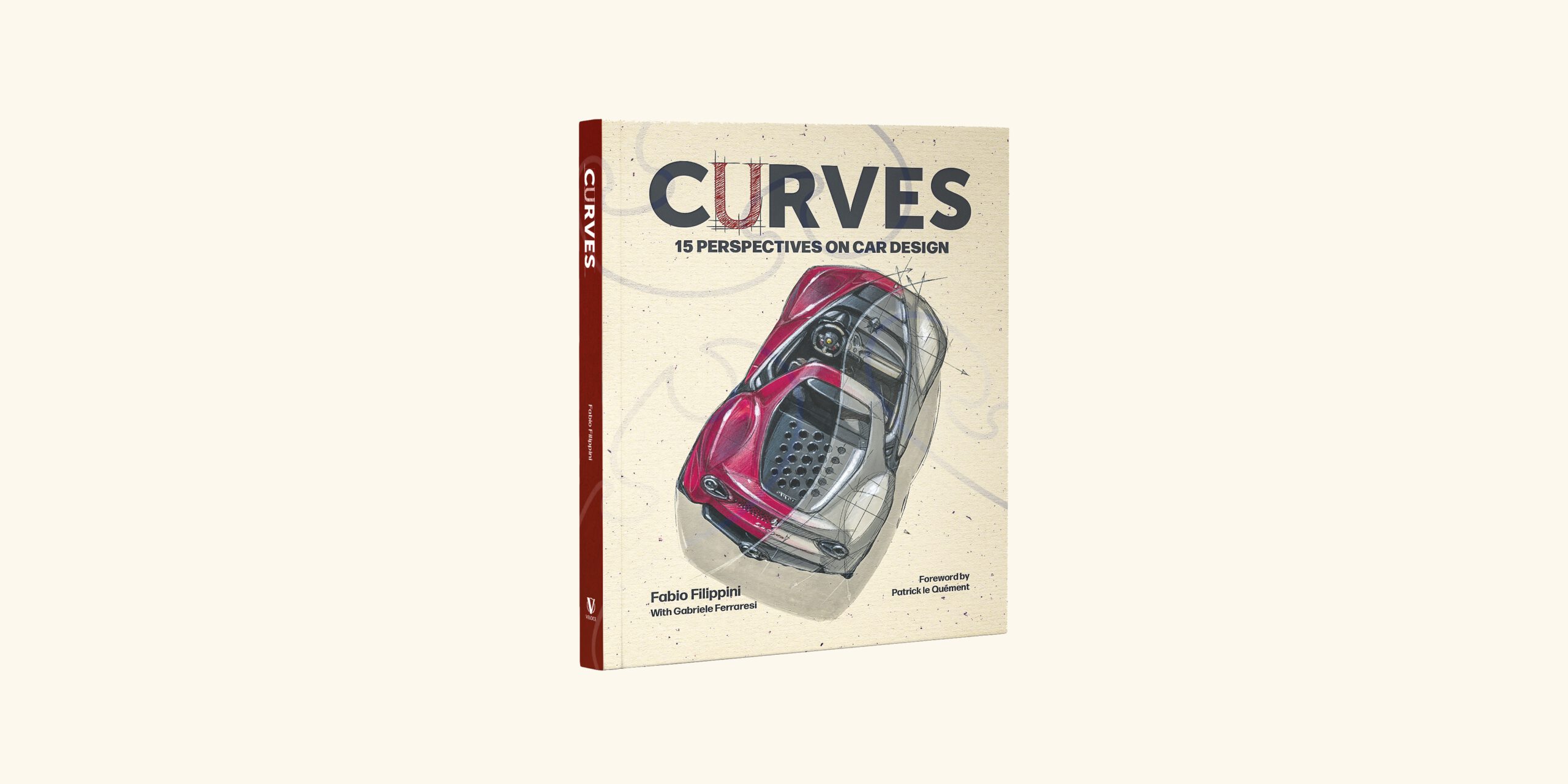
As a former Design Director at Pininfarina, Fabio Filippini draws on four decades of experience in his book Curves: 15 Perspectives on Car Design. He explores how cars are designed, but also why certain forms endure while others quickly become dated.
One of the book’s most compelling aspects is the way Filippini explains how and why the car’s influence is so widespread and strong: ‘A car is the only mass-produced item where all the most sophisticated functions, disciplines and technologies of human cognition converge and interact. The car has it all, from technical and industrial to humanistic and social, from space-management and land-use to artistic expression (visual or sculptural), from information and communication to comfort and safety. Unlike other consumer goods, the automobile not only integrates all these complex factors into a single product but also associates them with a fourth dimension: motion. It is motion that makes the very essence of a car so complex and fascinating and stirs the feelings and passion we’re familiar with. This combination of factors is why millions of people across the world aspire to car ownership.’
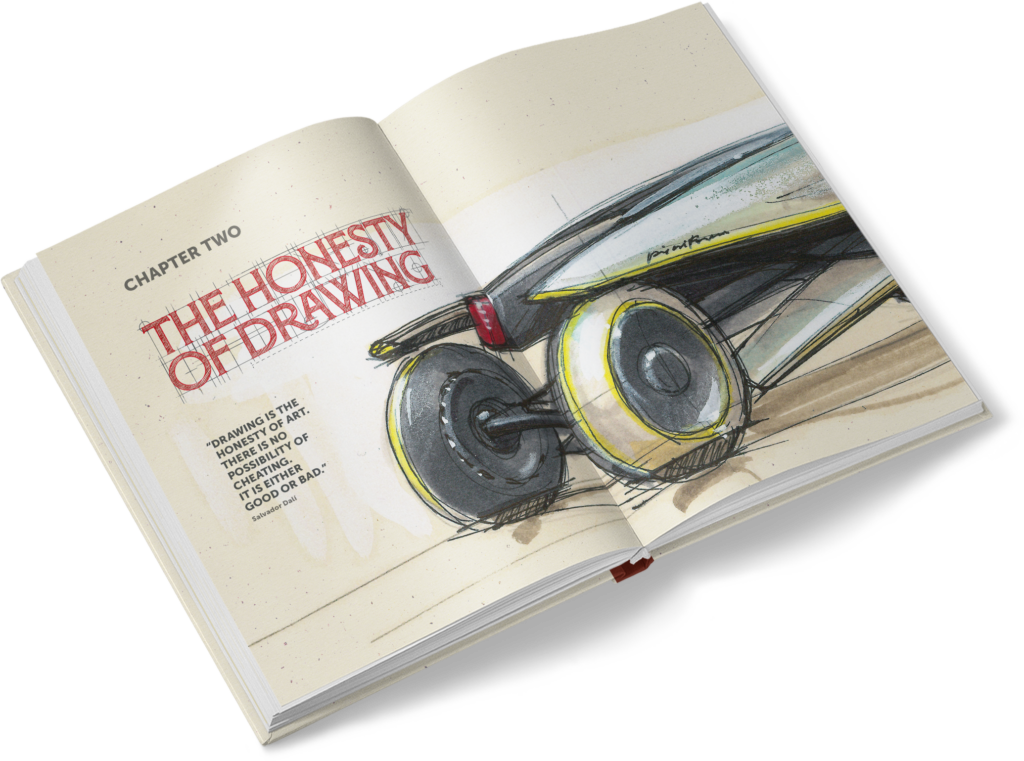

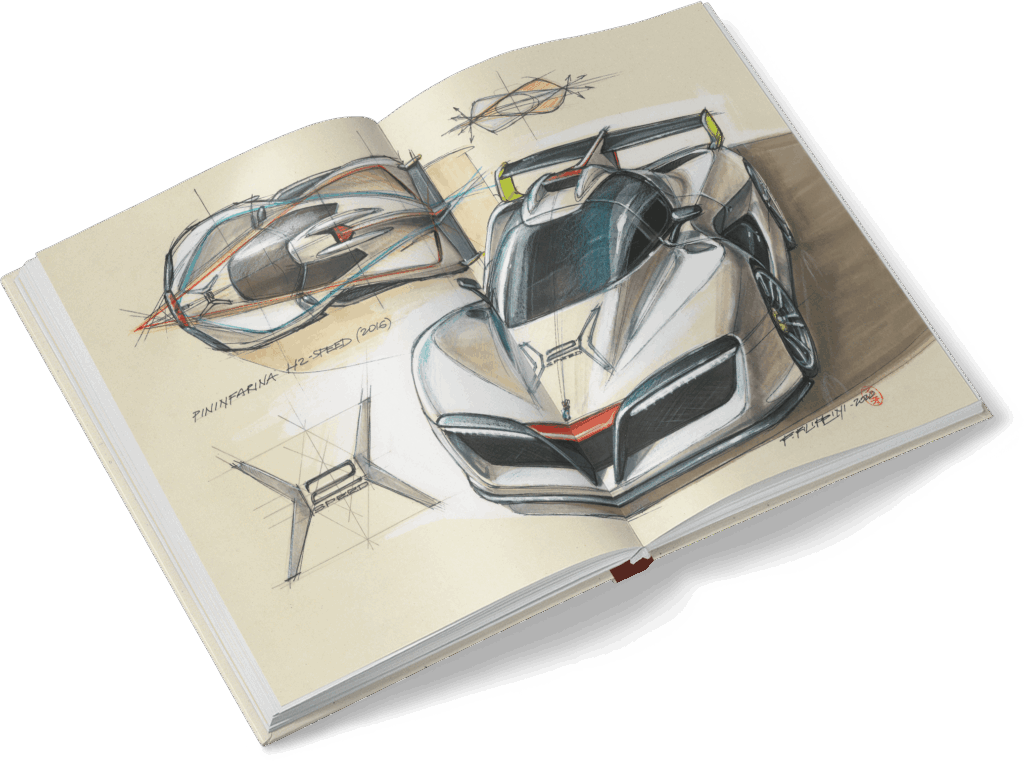
What makes Curves a must-read for car enthusiasts and for design aficionados, is the fact that an experienced designer seems to be sitting down with the reader to explain his craft. He shares the thinking that starts well before the first lines are drawn, giving insights into the thought processes of individual designers, design teams and even entire design departments responsible for turning creative ideas into production automobiles.
One of this book’s greatest strengths is Filippini’s examination of the delicate balance between artistic vision and industrial reality. He explains how seemingly minor alterations can undermine an otherwise successful design, sometimes requiring a return to the original sketch. He also offers a perspective on customer clinics: a design that appeals unanimously may be precisely the one to question, since its conformity to contemporary tastes risks making it appear dated by the time it reaches dealers.
Filippini’s critical observations regarding present-day design trends are very insightful as well. He does not bluntly criticise other designers or their work, but instead gives detailed explanations of certain trends. The ever-increasing size of wheels, for instance, the proliferation of unnecessarily complex surfaces and the preference for sharp, angular forms all come under scrutiny. For Filippini, modernity should not be confused with complexity because genuine sophistication often lies in knowing what to remove. He underlines this by saying: ‘True modernity is the exact opposite of randomly included complex and multi-faceted surfaces: simplifying the expression of our ever-more complex universe, and reducing pointless details to a minimum… And possibly not just in cars.’
His reflections on proportion are an integral part of this, but simultaneously a result of his time at Pininfarina, the masters of proportion, making it a lecture in the significance of strong sketching skills. ‘Proportions and the essential elements can be brought into focus, by viewing with the eyes half closed to purposefully blur out details, which might act as noise. This is a way to keep the shape and the spirit of the original sketch intact’, Filippini explains.

The differences between cultures and their influence on design are also touched on in Curves. ‘Italian design is commonly associated with sportiness, proportional elegance and stylistic innovation, German design with quality and sturdiness, and Japanese design with attention to details, while French design is associated with originality and anti-conformism.’ Having worked in Japan, then at Renault in Paris, at Pininfarina and on a significant project with BMW, Filippini is qualified to evaluate the various nationalities and their influence on automotive design. This breadth of cultural exposure taught him how to look at design in a different way: not just from the right distance and in the right lighting, but also in the right environment. A Nissan Cube in Paris or a Renault Clio in Tokyo might look exotic compared to the background of their respective home markets.
Few readers will be aware of the differences between exterior and interior design. Among designers, there are strong standpoints on the significance of each, but Filippini unfolds the details, providing insight into why interior design might be even more difficult. ‘From the outside, a car can be viewed as a sculpture. From the inside, however, it’s a living space.’ His vision of how to combine design, ergonomics and communication into a welcoming environment will keep the reader drawn to the pages even longer.
In Curves, the uneasy conversation about creativity and the influence of artificial intelligence is not avoided, and Filippini does not even judge it harshly. ‘The real question today is not whether to use AI: it is how to use it in the service of creativity, and not instead of creativity.’
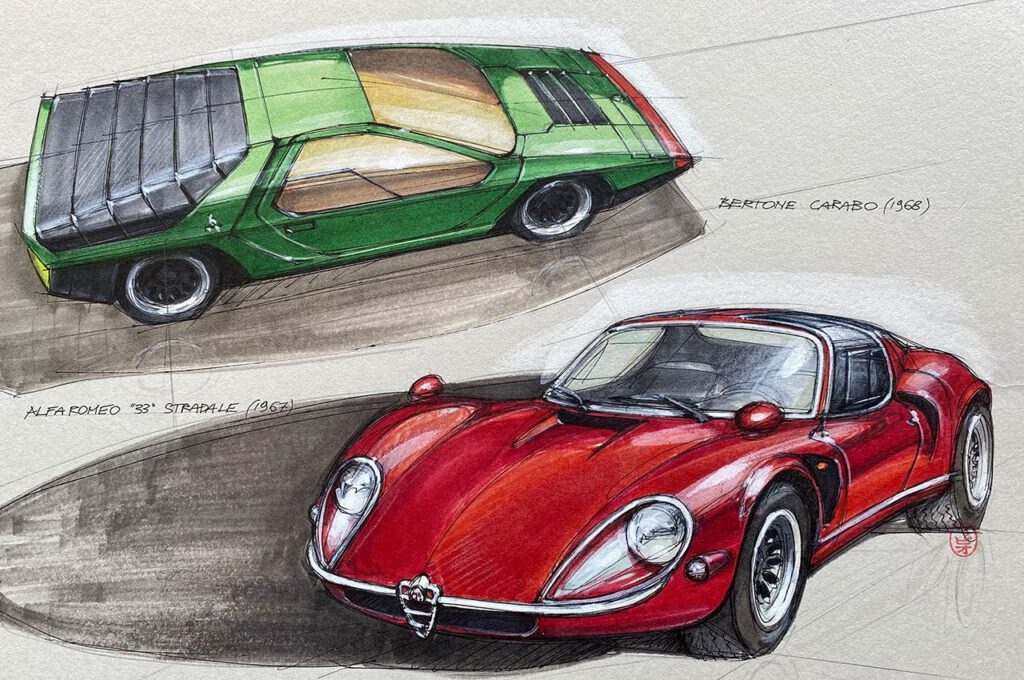
The discussion of automotive history is equally revealing. Filippini’s comparison of the Alfa Romeo 33 Stradale with the Bertone Carabo might come across as daring, but it illustrates how rapidly design language can evolve, even within a relatively short period. With observations like these, Filippini demonstrates that automotive beauty cannot be separated entirely from its historical context.
The book’s extensive illustrations all come from the author’s hand, making Curves even more interesting. If we were to give one minor reservation, it would be in terms of the paper, which feels a little too magazine-like compared to some other, more high-end automotive publications.
Ultimately, Curves is far more than 15 perspectives on car design or a collection of fascinating sketches. It is an insightful and unusually personal exploration of design thinking, combining practical knowledge with a considered critique of contemporary styling. For readers interested in the discipline, history and philosophy of automotive design, Filippini offers an engaging masterclass in learning not merely to look at cars, but to understand them.
- AuthorFabio Filippini
- LANGUAGEEnglish
- PublisherVeloce Publishing
- PAGES240
- Websiteveloce.co.uk/products/curves
- Price£24.99
- Interesting subject
- Expert opinion
- Price
- Great sketches
- Paper quality
Written by a veteran with forty years in the industry, Curves guides the reader through the entire design process, from the thinking before the first sketch to evaluation after series production. Essential reading for anyone curious about automotive design, as well as the history and the future of it.
Support Motorcar Journal
Donate a tank of fuel
